Manufactured Home Heating and Air: What’s Important To Know
Last Updated on July 28, 2026 by Chad Peterson
Manufactured home HVAC ended up being one of my favorite niches later in my career. As an older guy, I liked that I could install a new heat pump and get the whole job done in about two days without killing myself over it. And the people I worked for were about as down-home and genuine as they come.
Some folks still call these mobile homes, though manufactured home is the correct term these days, and the one I’ll use here. Either way, the equipment, the ductwork, and the way the whole system is installed is different from what you’d find with a stick-built home over a crawl space or a basement.
Those differences cause a specific set of problems I saw over and over across 45 years in the trade — problems that don’t really come up in a stick-built house.
Excessive Noise Has Always Been A Big Issue
Many of my customers have had to turn up the volume on whatever they are listening to when the furnace comes on. The noise is usually created by the proximity of the furnace to the living space and the lack of enclosure.
Over the years, I’ve tried many things to reduce the noise. One of the most successful ideas I’ve had was to add a more efficient filter in a rather creative way. But this idea is restricted to the type of closet the furnace is in.
I’ve written an entire article showing the furnace closet and filter, with photos, if you want to see exactly what I mean: upgrading the filter setup on a mobile home furnace.
The Crossover Duct Is the Weak Link
Cats and rats are the biggest culprits in my area. They go after the warmth of the duct, especially in winter. Some critters are hard to keep out of the crawl spaces, and they eat right into the flex duct of the crossovers. We have had to replace the flex with metal pipe.
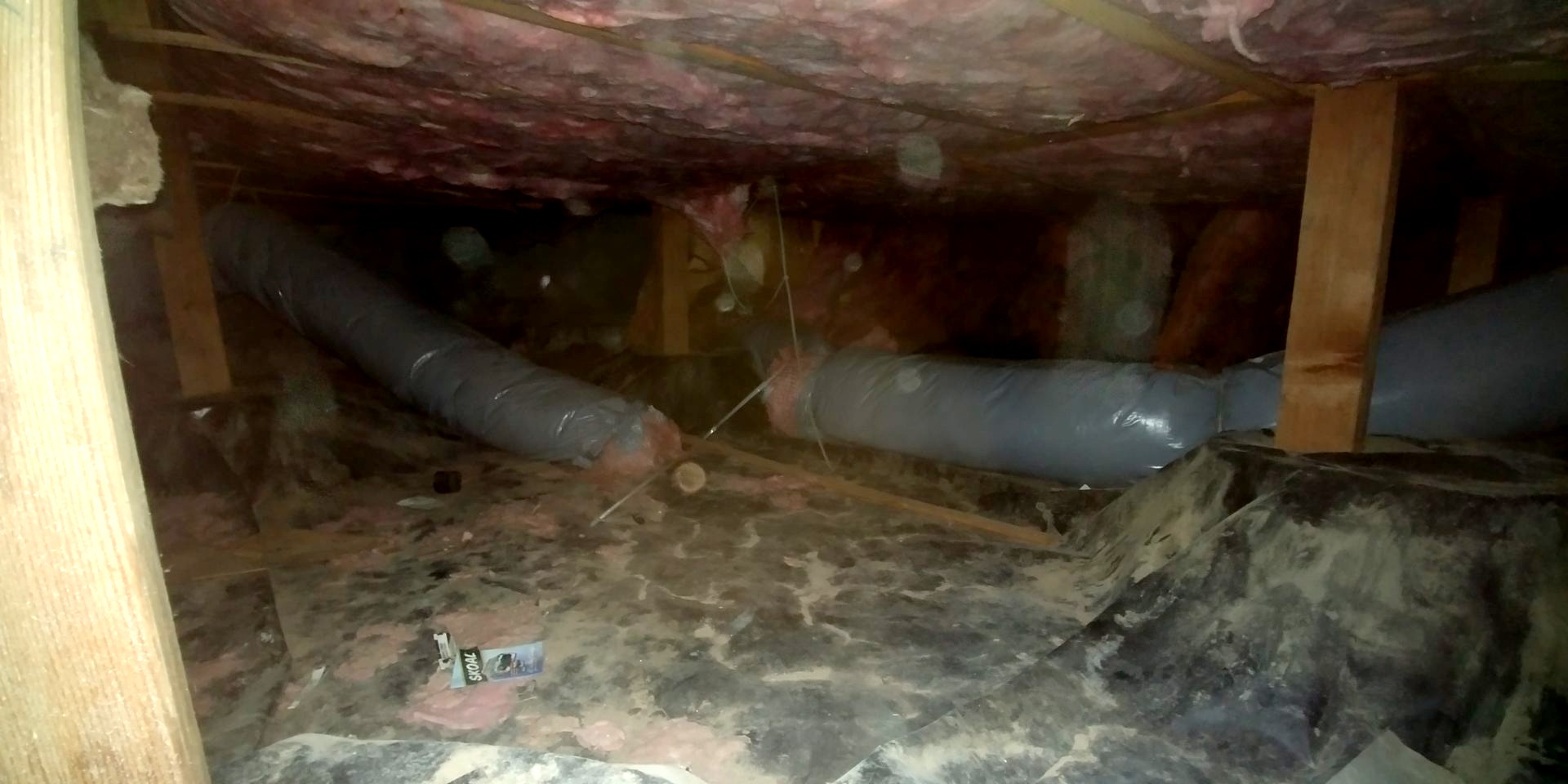
One of my customers loved his feral cats. He left the crawl space open for them to keep warm in the winter. It cost him thousands of dollars to repair the ducting to say nothing about the smell.
In winter, if you open the crawl space access and feel warm air, you can be sure the crossover has been torn into or has fallen. Sometimes they just fall off because of installer issues.
If one side of the home runs warm and the other side has limited or no airflow, the crossover duct is the first thing I’d check.
Not Every Furnace Is Approved for a Manufactured Home
Manufactured homes built under the HUD code require equipment that’s specifically listed and approved for manufactured housing. If you plan on getting permits to change an existing furnace you need to check with your local housing authority to see if they will pass it. It varies from place to place.
Combustion air requirements, clearances, and installation instructions are all different because of the tighter space and the way the home is constructed. In some manufactured homes you can look above the furnace and see a flex duct hanging down in the furnace compartment.
This duct is meant to bring in fresh air to help vent off-gassing from new materials in the home. The problem is that it also brings in hot air in the summer and cold air in the winter, and you pay to condition that air.
If your home is older, the off-gassing is mostly over. I have plugged off many of these fresh air contaminators. I’m not suggesting you plug your outside air duct. It’s purely your decision. Unless you think you may get a visit from the fresh air police.
If you’re getting bids for new equipment, you now have some questions to ask. There are a lot of questions you can ask when buying new HVAC. I’ve listed a bunch in this article.
The Belly Wrap Is Doing More Work Than People Realize
The belly wrap is the fabric barrier stretched underneath the home that holds the floor insulation in place, and on a lot of homes it also encloses the ductwork. When it sags, tears, or gets pulled down by animals, you lose insulation value in that spot, and the ductwork underneath can end up exposed to outside air, moisture, and pests.
I’ve seen firsthand a lot of abuse by contractors who make repairs under manufactured homes. They cut the belly wrap to get in, then leave it open, exposed to everything it was installed to protect you from.
This is behind two complaints I heard all the time: “why is my floor always cold, even when the heat’s running fine,” and “why do my pipes freeze in winter.” A sagging or torn belly wrap under one part of the house is usually the answer.
Get The Right Size AC, Or You Could Suffer
Here’s some good news, though: sizing a manufactured home is usually the easy part, not the hard part. Bigger is not better when sizing heat pumps and air conditioners. If you oversize your AC you may not remove enough humidity. An oversized AC will short cycle before lowering humidity.
Manufactured homes are built to a standardized HUD code, with consistent wall, roof, and floor construction coming out of the factory. A stick-built house might have additions, mixed insulation from different decades, and a dozen custom quirks that make an accurate load calculation genuinely difficult. A manufactured home mostly skips that problem.
That doesn’t mean you should skip the load calculation. It just means whoever’s doing the math has a lot less guesswork and a lot less excuse for getting it wrong.
The Short Version
A manufactured home isn’t just a mobile house — they are homes to millions of people all over the world. The ductwork runs differently, the equipment has its own approval requirements, the belly wrap is protecting more than people realize, and sizing is actually more straightforward than most people expect, not less.
Most of the troubleshooting rules for a stick-built home still apply once the air’s actually moving through the house, but the crossover duct, the belly wrap, and the equipment approval are the three things I’d check first that a stick-built homeowner would never have to think about.
Airflow direction matters just as much in a manufactured home as anywhere else — see how to determine your furnace’s airflow direction if you’re not sure which way yours is set up.